Stretching on Deck Won't Save You in the Water: The Mobility Gap Most Swimmers Never Close
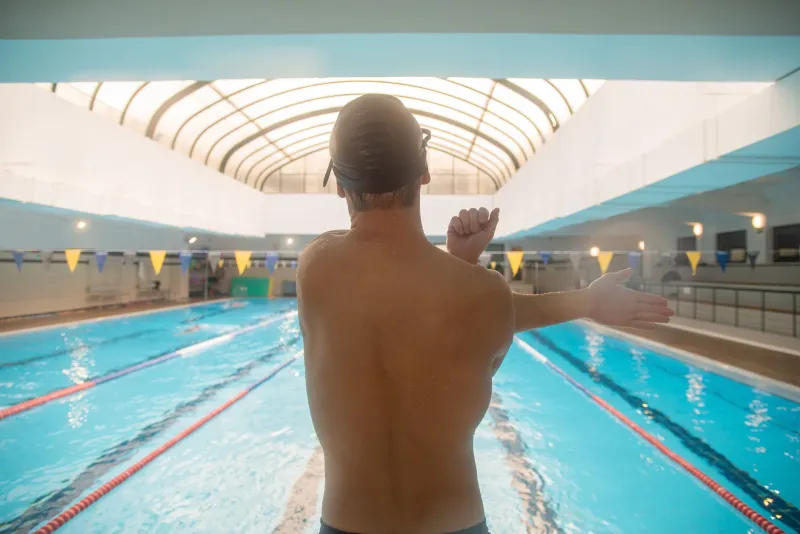
Picture this: you've been hitting a solid 20-minute stretching routine before every practice. Hamstrings, hip flexors, shoulder circles, maybe even a few yoga poses you picked up from a YouTube tutorial. You feel loose. You feel ready. Then you jump in the water, and somewhere around your third lap, your catch feels stiff, your rotation is limited, and your kick looks nothing like it did when you tested it standing on the deck.
Sound familiar? You're not alone. And no, you're not doing the stretches wrong.
The real issue is that flexibility and water-specific mobility are two genuinely different things — and confusing them is quietly costing swimmers at every level.
Why the Pool Changes Everything
On land, your body operates in a world it understands. Gravity is consistent, your feet are planted, and your proprioceptive system — basically the internal GPS that tells your brain where your limbs are — gets constant feedback from the ground beneath you.
The moment you enter the water, all of that changes. You're horizontal. Gravity's influence shifts. The resistance your muscles are pushing against is dynamic and three-dimensional. And your proprioceptive system, which has been calibrated your entire life for upright, land-based movement, suddenly has to recalibrate in real time.
This is why a swimmer can sit in a perfect butterfly stretch on deck — hips open, toes pointed, back flat — and then get in the water and feel like their hips are made of concrete. The range of motion exists. The neuromuscular pathway to use that range of motion in a horizontal, load-bearing, aquatic environment? That's a completely different story.
The Proprioception Problem
Here's the part most coaches skip over: flexibility is passive. It describes the maximum range your joints can move through when you're relaxed and not under load. Mobility is active. It's how much of that range you can actually access and control while your muscles are firing, your body is rotating, and water is pushing back against you.
Underwater, proprioception takes a hit. Sensory input from the skin changes because of hydrostatic pressure. The inner ear adjusts to a different orientation. The tactile cues your nervous system uses to judge limb position are muffled. What this means practically is that your brain has a harder time knowing exactly where your arm is during the pull phase, or whether your ankle is actually plantarflexed or just feels like it is.
Static stretching on deck does almost nothing to address this. You're training range of motion in an environment your body already understands, in positions that don't replicate the load patterns of swimming. It's a little like training for a marathon by practicing walking slowly in a parking lot. Technically related. Practically useless.
What Dry-Land Mobility Work Actually Transfers
This isn't an argument against all land-based training. It's an argument for being smarter about which land-based training you prioritize.
The mobility work that actually shows up in the water tends to share a few characteristics:
It's dynamic, not static. Controlled leg swings, arm circles with resistance bands, hip CARs (controlled articular rotations) — these train your joints through active range of motion, which is far closer to what swimming demands than a held stretch.
It mimics swimming positions under load. Prone Y-T-W exercises, rotator cuff activation work, and thoracic rotation drills in positions that approximate your body's orientation in the water all help bridge the gap between land and pool.
It trains proprioception directly. Balance board work, single-leg stability exercises, and closed-eye movement drills all challenge your nervous system's ability to sense and control position — which is exactly what gets disrupted when you go horizontal in the pool.
It addresses the specific joints that matter for your stroke. For freestyle and backstroke, thoracic spine rotation and shoulder internal rotation are critical. For breaststroke and butterfly, hip external rotation and ankle flexibility are the limiting factors. Generic full-body stretching routines treat all of these the same, which means they serve none of them particularly well.
The Ankle Flexibility Problem Nobody Talks About
Let's use ankle flexibility as a concrete example, because it's one of the most misunderstood mobility issues in swimming.
A lot of swimmers know that plantar flexion — the ability to point your foot — is crucial for an efficient kick. So they sit on their heels, stretch their ankles, and feel good about it. But here's the catch: the resistance pattern of water means your ankle needs to be actively maintaining that position through the entire kick cycle, not just passively holding it when you're relaxed.
If you haven't trained your peroneals and tibialis posterior to fire correctly while your hip flexors and glutes are also working in a horizontal position, your ankle flexibility is basically decorative. You have the range. You just can't use it when it counts.
The fix isn't more ankle stretching. It's adding banded ankle exercises in prone positions, kick sets with fins that train the neuromuscular pattern, and targeted single-joint drills that isolate ankle control while the rest of the body is moving.
Building a Routine That Actually Works
If you're going to spend time on mobility — and you should — here's a rough framework that's more likely to show up in your splits:
-
Pre-practice: Short, dynamic sequences only. Leg swings, arm circles, hip openers in motion. Five to eight minutes max. The goal is activation, not lengthening.
-
Post-practice: This is when longer, more passive work makes sense. Your muscles are warm, your nervous system is primed, and you're not about to ask your body to perform. Hold stretches here — especially for hip flexors and shoulders.
-
Off-days: This is when deliberate mobility training belongs. Spend 15-20 minutes on targeted CARs, resistance band work, and proprioceptive drills. Make it specific to your stroke and your known limiters.
-
In-water drill work: Don't underestimate this. Sculling, catch-up drill, single-arm butterfly — these are mobility exercises happening in the actual environment where the mobility needs to exist. They train range of motion with water resistance as the load, which is exactly what you need.
The Bigger Picture
The swimming world has borrowed a lot from general fitness culture, and not all of it translates. Static stretching has its place — it's not worthless — but the idea that logging time on a yoga mat is going to unlock your underwater range of motion is a myth worth retiring.
Your body is smarter than a simple input-output machine. It doesn't just need range of motion. It needs range of motion it can access, control, and sustain under the specific conditions of your sport. In water. Horizontal. Under load. With your proprioceptive system working overtime.
Train for that, and your mobility work will finally start showing up where it matters — in the pool, on the clock, and in the races that count.