More Kick, Less Speed: The Surprising Truth About What Your Legs Are Actually Doing in the Water
There's a moment most swimmers know well. You're coming into the final 25 yards of a race, the lactic acid is stacking up fast, and your instinct screams one thing: kick harder. It feels like the right call. More power, more propulsion, more speed. Except the data tells a very different story — and once you understand it, you'll never look at your legs the same way again.
The assumption that leg power equals swimming speed is one of the most persistent myths in competitive swimming. And it's quietly costing athletes at every level — from age groupers grinding through their first club season to masters swimmers who've been racing for decades.
What the Research Actually Shows
Here's the uncomfortable truth: in freestyle swimming, the legs contribute somewhere between 10 and 15 percent of total propulsive force. The arms are doing the heavy lifting — always. Studies in sports biomechanics consistently show that elite swimmers don't generate more speed by kicking with greater intensity. They generate it by kicking with greater efficiency.
When researchers have measured oxygen consumption in swimmers isolating their kick versus their full stroke, the numbers are striking. Kicking alone burns an enormous amount of energy relative to the propulsion it creates. A swimmer who over-relies on their kick is essentially running their engine at high RPM while barely moving forward — all fuel, minimal output.
That energy cost matters enormously in race conditions. Every calorie your legs burn unnecessarily is a calorie your arms can't use to maintain stroke rate and power through the back half of your race.
The Drag Problem Nobody Talks About
Energy waste is only part of the problem. The bigger mechanical issue with an overpowered kick is what it does to your body position — and consequently, to drag.
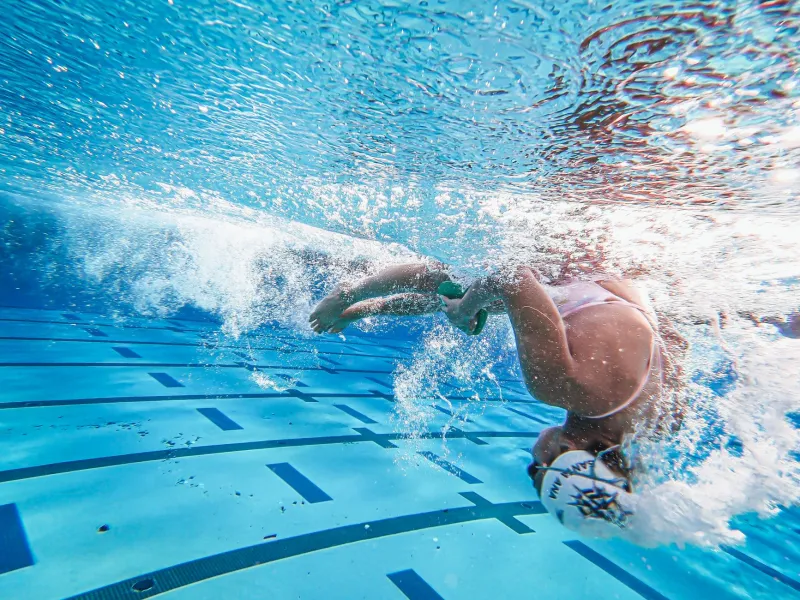
When swimmers kick too wide or too deep, the legs act like a parachute rather than a propeller. The feet drop below the body's horizontal plane, the hips sink slightly, and suddenly you're fighting a wall of resistance with every stroke cycle. Hydrodynamic drag increases exponentially with frontal surface area. Even a modest drop in body position can add meaningful resistance over the course of a 100 or 200 freestyle.
There's also the rotational disruption to consider. A well-timed, compact kick supports the body's natural rotation through the stroke cycle. An aggressive, wide-amplitude kick fights that rotation, creating lateral instability that forces the arms to compensate — and that compensation typically shows up as a shortened catch or a rushed recovery.
In short, kicking too hard doesn't just waste energy. It actively makes your stroke mechanics worse.
What Elite Swimmers Are Actually Doing
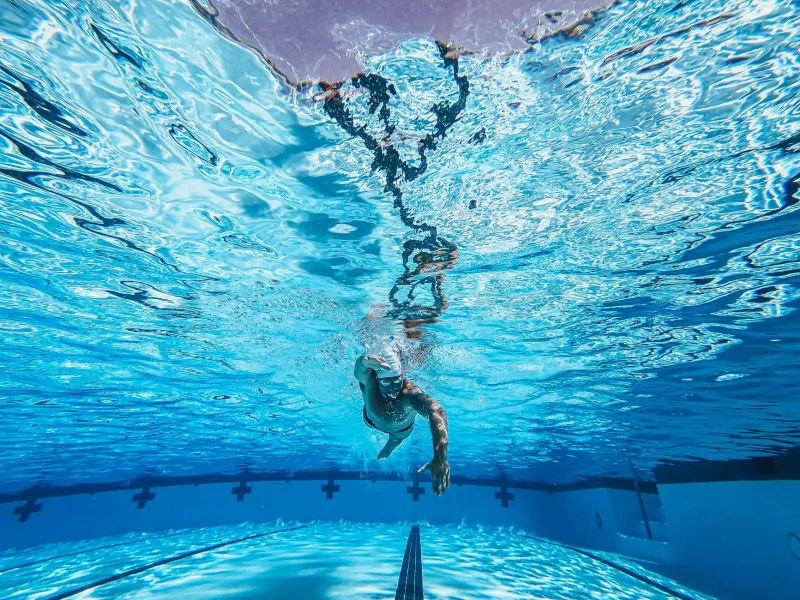
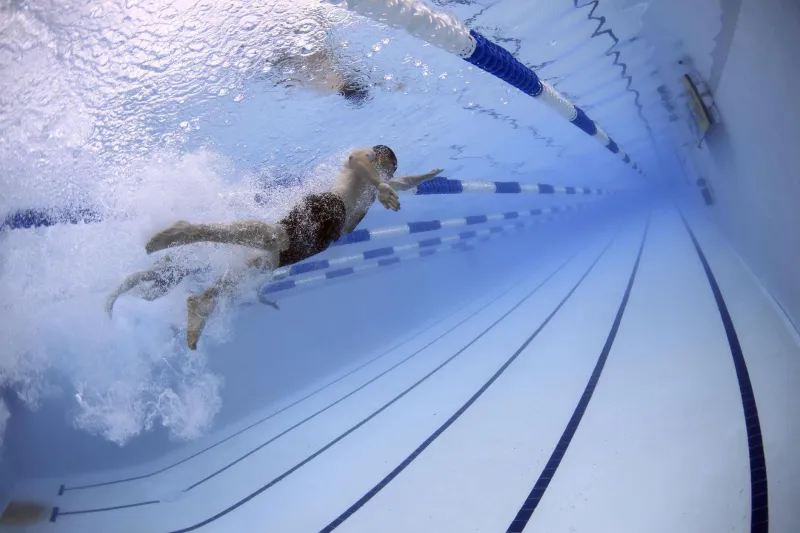
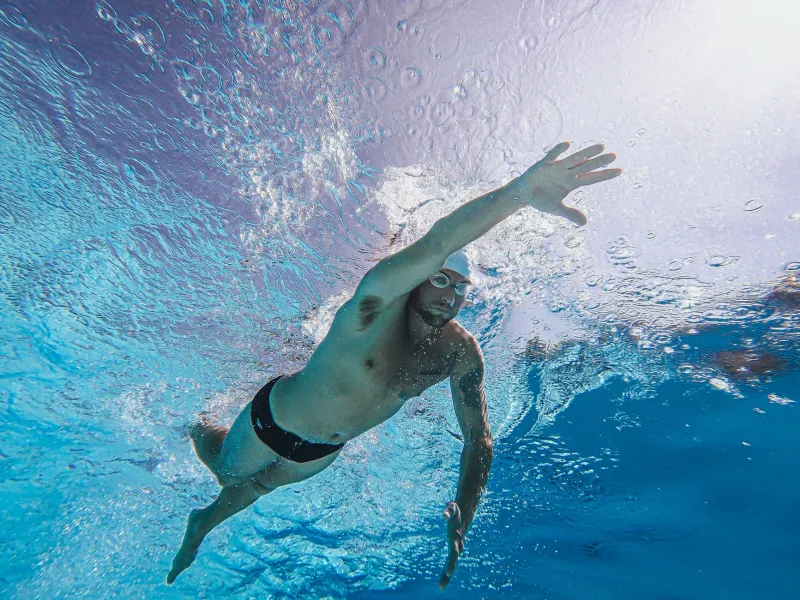
Watch underwater footage of elite freestylers — the kind of slow-motion video that USA Swimming and college programs use for stroke analysis — and you'll notice something that surprises a lot of developing swimmers. The kick looks... relaxed. Compact. Almost casual compared to what you'd expect from someone moving at that speed.
That's not an accident. World-class swimmers have refined their kick to serve a specific purpose: maintaining body position and timing the rotation, not generating raw propulsion. The kick is a stabilizer and a rhythm keeper. The arms are the engine.
The amplitude is typically narrow — often no more than 12 to 18 inches between the feet at full extension. The ankles are loose and flexible, which allows the foot to act like a fin rather than a paddle. And the effort level, relative to what age-group swimmers tend to do, is surprisingly low.
This is what coaches mean when they talk about a "two-beat kick" in distance events or a "six-beat kick" in sprints — the number isn't about intensity, it's about coordination and timing with the arm cycle.
Rebuilding Your Kick From the Ground Up
If you've been hammering your kick under the assumption that harder means faster, the fix isn't complicated — but it does require some intentional practice.
Start with ankle flexibility work. Tight ankles are the number one limiter for efficient kicking. If your foot can't plantarflex well, it can't generate any meaningful propulsion regardless of how hard you kick. Spend five minutes before every practice doing seated ankle circles and gentle foot stretches. Over time, this alone can transform your kick mechanics.
Kick on your side. Side-kicking drills force you to keep your kick compact because any wide movement throws off your balance immediately. You get real-time feedback on amplitude and body position in a way that standard board kicking doesn't provide.
Try the "no-board, no-pull-buoy" drill. Swim easy freestyle with a deliberate focus on reducing kick effort by about 40 percent from your normal intensity. Pay attention to what happens to your stroke. Most swimmers find their catch improves and their rotation becomes smoother — because the legs are no longer disrupting the rhythm.
Use tempo to regulate kick cadence. A FINIS Tempo Trainer or similar device can help you sync your kick beats to your stroke cycle rather than kicking independently of your arms. Disconnected kicking is one of the most common causes of energy waste in age-group swimmers.
The Mindset Shift That Makes It Stick
Here's where the mental side of this gets tricky. Kicking harder feels faster. It feels powerful. It gives you something to do when the race gets hard, which is psychologically satisfying in the moment.
Breaking that habit requires reframing what "working hard" looks like in the water. Real effort in swimming is about maintaining stroke mechanics under fatigue, keeping your catch pressure consistent, and not letting your body position collapse when the lactic acid hits. None of that looks dramatic from the pool deck. But it's what actually moves the clock.
The athletes who make the biggest gains with this shift are usually the ones who've been swimming for years and plateaued. They've done the yardage. They've put in the time. But they've been unknowingly fighting themselves with every kick cycle.
Less Really Is More
AquaForge is built on the idea that smarter training beats harder training — and the kick is one of the clearest examples of that principle in action. The water doesn't reward effort for effort's sake. It rewards efficiency, precision, and an honest understanding of what's actually driving your speed.
So the next time you're tempted to hammer your legs through the back half of a tough set, try the opposite. Ease off, tighten up the amplitude, and let your arms do their job. You might be surprised how much faster doing less actually feels.