Why Your Stroke Crumbles at the Worst Possible Moment — And How to Stop It
The Moment Everything Goes Wrong
You know the feeling. You're 75 yards into a 100 free, lactate is stacking up fast, and somewhere around the third turn your elbow drops, your hips sink, and the stroke you've been grooming all season basically disappears. You finish, check the scoreboard, and wonder how you could possibly swim worse than you did in practice.
Welcome to stroke decay — one of the most frustrating and least talked-about problems in competitive swimming. It's not a fitness issue. It's not a willpower issue. It's a neuromuscular timing issue, and understanding why it happens is the first step toward actually fixing it.
The Gap Between Knowing and Doing
Here's the thing about technique work: your brain learns movement patterns in a very specific context. When you drill a high-elbow catch at 60% effort in a quiet practice pool, your nervous system encodes that movement under those exact conditions — low metabolic stress, steady breathing, full cognitive bandwidth. That's what sports scientists call a low-arousal motor pattern.
Now throw yourself into a race. Heart rate spikes. CO2 climbs. Your prefrontal cortex — the part of your brain that consciously monitors and corrects movement — gets partially hijacked by the sympathetic nervous system. Your body shifts resources toward survival-mode output, and those carefully rehearsed motor patterns? They get bumped down the priority list.
What your nervous system defaults to instead is the movement pattern it's logged the most hours doing — which, for most swimmers, is some version of whatever you swam before you started refining things. Old habits don't die under pressure. They come back to life.
Researchers call this skill regression under fatigue, and it's well-documented in motor learning literature. The neuromuscular adaptation you built in drills hasn't been stress-tested enough to become truly automatic. It's still a conscious skill, not a hardwired one.
Breath Control: The Breaking Point Nobody Talks About
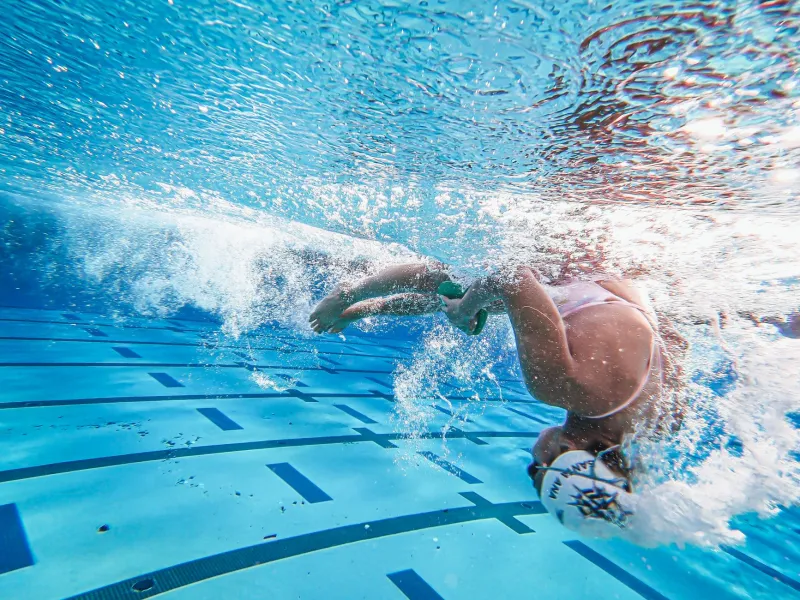
If stroke decay has a trigger, it's almost always breathing. Watch any age grouper's underwater footage from the back half of a race and you'll see the same sequence: the head lifts too early, the lead shoulder drops, the catch collapses. It's not random — it's the direct mechanical consequence of a desperate breath.
When your body's carbon dioxide tolerance is exceeded, the urge to breathe overrides technical discipline. Your neck muscles fire prematurely, pulling your head out of alignment before the stroke is complete. That single movement creates a chain reaction: disrupted body rotation, dropped elbow, shortened pull, reduced propulsion. One bad breath pattern can cost you a body length over 100 yards.
The cruel irony is that most swimmers train their breathing pattern at comfortable intensities, which means it's never been stress-tested at race pace. Your breathing under fatigue is essentially untrained — and it's dragging everything else down with it.
Locking It In: What Actually Works
The solution isn't more drilling at low intensity. You already have the pattern — you just can't access it when it counts. What you need is to rehearse correct technique specifically under fatigue, so your nervous system starts encoding the movement in a high-stress context.
Hypoxic Breathing Sets (Done Right)
Breathing every 5 or 7 strokes on moderate-intensity sets isn't just a lung capacity exercise — it's a technique stress test. When you restrict breathing, CO2 rises and the urge to rush intensifies. That's exactly the condition where your stroke falls apart in a race. Practicing your catch and rotation while managing that discomfort starts building a stress-resistant motor pattern.
Start with a set like 8x50 on 1:10 at 80% effort, breathing every 5 strokes. The goal isn't survival — it's maintaining your catch position through the discomfort. Have a teammate or coach watch your elbow from the deck. If it drops, you haven't unlocked the adaptation yet.
Threshold Technique Repeats
This is the big one. Pick your most technically fragile element — maybe it's your two-beat kick timing, your hand entry angle, or your hip rotation depth — and then swim a set at or above lactate threshold while consciously monitoring that single element.
Try 5x100 at 90-95% effort with 30 seconds rest, focusing exclusively on one technical cue per rep. You're training your nervous system to access that cue when lactate is high. It's uncomfortable, it's hard to hold form, and that's exactly the point. The discomfort is the training stimulus.
Dryland Neural Priming
Before you dismiss this as bro-science, hear it out. Dryland activation work — specifically resistance band pull-through drills that mimic your catch and pull — done immediately before a technique-focused water set can accelerate neuromuscular encoding. The idea is to fire the exact motor pathway you want to reinforce, then get in the water and execute it while the neural signal is fresh.
A simple protocol: 3 sets of 15 band pull-throughs focusing on elbow-high position, then immediately swim a 200 at race pace. Your brain has just been reminded what the correct pattern feels like. You're more likely to hold it under stress.
CO2 Tolerance Training
This one directly attacks the breathing problem. Short, intense hypoxic sprints — 10x25 on 40 seconds, maximum effort, breathing only at the walls — build your tolerance to elevated CO2. Over time, your threshold for the panic-breath reflex rises, which means your stroke mechanics stay intact deeper into a race.
This isn't a high-volume prescription. Two CO2 tolerance sets per week is plenty. More than that and you're just accumulating fatigue without additional adaptation.
The Mental Layer
There's also a cognitive piece that's easy to overlook. Under competitive pressure, attention narrows. External cues — the swimmer in the next lane, the scoreboard, the crowd — pull focus away from internal technical monitoring. That's normal and expected. But you can train attentional control the same way you train a catch.
Before your next hard set, pick one internal cue — "high elbow" or "long rotation" — and commit to it as your only mental focus for the entire set. No split math, no lane awareness. Just that one cue. You're building the habit of internal attention under stress, which is exactly what you'll need in a race when everything else is screaming for your focus.
The Bottom Line
Stroke decay isn't a character flaw and it isn't a sign that your technical training isn't working. It's a predictable consequence of how the nervous system learns — and it has a clear, trainable solution. You need to stop rehearsing technique only when it's easy and start building it where it actually needs to live: at the edge of your capacity, when your lungs are burning and your brain is begging you to just survive the rep.
That's where the real adaptation happens. That's where races are won.