The Price of a Perfect Catch: How Chasing Stroke Perfection Is Quietly Wrecking Your Shoulders
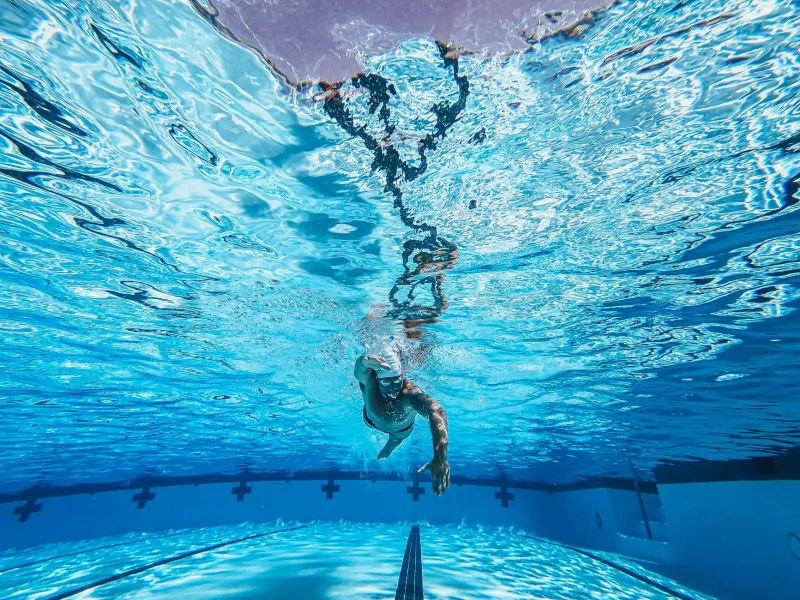
Walk into any competitive swim practice in the country and you'll hear the same cue repeated until it becomes white noise: get that elbow up. High elbow catch mechanics have become the gold standard of modern freestyle technique, and honestly, for good reason — when it works, it works brilliantly. You engage more of your lat, generate more pull surface, and slice through the water with noticeably less drag.
The problem? For a significant chunk of swimmers, that same movement pattern is quietly loading the rotator cuff in ways the shoulder was never designed to handle at high volume. And the worst part is that the damage often starts long before anything actually hurts.
What's Actually Happening Inside the Shoulder
The rotator cuff isn't one muscle — it's four: supraspinatus, infraspinatus, teres minor, and subscapularis. Together they stabilize the humeral head inside the glenoid socket, essentially keeping your arm from flying out of the joint every time you pull. Under normal conditions, they're remarkably good at their job.
But the high elbow catch position demands that the shoulder operate at extreme internal rotation while simultaneously generating significant force. That combination creates a narrowing of the subacromial space — the small gap between the top of your humerus and the acromion bone above it. When that space gets compressed repeatedly, the tendons running through it start to fray. That's impingement, and it's the most common overuse injury in competitive swimming by a wide margin.
Research from the American Journal of Sports Medicine has consistently shown that elite-level swimmers report shoulder pain at rates between 40 and 70 percent depending on the study population. That's not a freak accident stat — that's a structural problem embedded in how the sport is trained.
The Volume Problem Nobody Talks About Loudly Enough
Here's the thing about swimming that makes shoulder mechanics so uniquely dangerous: volume. A competitive high school swimmer might log 20,000 yards in a single week. A college swimmer could push 30,000 or more. Each yard involves roughly one full shoulder rotation cycle per arm stroke. Do the math and you're looking at tens of thousands of repetitions per week, all loaded through that same compromised position.
In most land sports, if a movement pattern is slightly off, you have gravity and rest working in your favor between reps. In the water, you're executing the same movement continuously, with no real opportunity for the shoulder to decompress between strokes. A minor biomechanical flaw that would be inconsequential in the weight room becomes a compounding problem in a 5,000-yard practice.
Coaches who prioritize stroke efficiency — and most good coaches do — sometimes inadvertently accelerate this process. A swimmer who fixes their elbow drop and develops a cleaner catch will almost always swim faster in the short term. But if their thoracic mobility, scapular stability, and rotator cuff strength aren't built to support that position, the clock is already ticking.
The Early Warning Signs You're Probably Ignoring
Shoulders don't blow out overnight. The process is gradual, and the early signals are easy to rationalize away when you're in the middle of a training cycle and times are dropping.
Watch for these:
Pain at the front of the shoulder during the catch phase. Not general soreness — a specific, localized pinch or ache right at the anterior deltoid or just underneath the AC joint. That's your subacromial space talking.
Weakness or instability during the pull-through. If you notice one arm feels significantly weaker mid-stroke after a hard set, especially if it wasn't like that six months ago, your rotator cuff is struggling to maintain joint stability under fatigue.
Night pain or discomfort when lying on your shoulder. This one gets dismissed constantly. Swimmers chalk it up to general training soreness. But rotator cuff tendinopathy has a classic signature of nighttime pain that worsens when you compress the shoulder, and it's a meaningful early indicator.
Clicking or catching sensations in the shoulder during arm circles or warm-up. Some noise is normal. Repeated mechanical catching — especially if it's new — isn't.
If two or more of those are showing up regularly, get in front of a sports medicine physician or physical therapist who works with swimmers before you're looking at an MRI.
The Biomechanical Tradeoff Nobody Wants to Make
Here's where it gets uncomfortable: there is a real tradeoff between the most mechanically efficient stroke and the stroke that preserves shoulder health over a long career.
The highest-performance catch position — maximum shoulder internal rotation, elbow well above the wrist and hand — generates the most propulsive force per stroke cycle. It's also the position that most aggressively loads the subacromial space. Backing off even slightly reduces propulsive efficiency. You may swim a touch slower in the short run.
But a swimmer who trains pain-free for 10 years will almost always outperform a swimmer who chases perfect mechanics for 4 years and then spends the next 2 managing a chronic shoulder injury.
The framework that makes the most sense for most athletes isn't "abandon the high elbow catch" — it's "earn the right to use it." That means:
-
Building genuine thoracic extension mobility. A stiff upper back forces the shoulder to compensate during the catch. If you can't extend through your thoracic spine, your shoulder will take the load instead.
-
Developing real scapular stability. Serratus anterior and lower trapezius strength keep the scapula properly positioned during the stroke. Without that foundation, the rotator cuff is working in a mechanically disadvantaged position on every single stroke.
-
Strengthening the external rotators directly. Swimmers are notoriously internally rotation-dominant. Adding targeted external rotation work — band pull-aparts, side-lying external rotation, face pulls — balances the cuff and protects the subacromial space.
-
Managing volume intelligently during technique transitions. If you're actively changing your catch mechanics, you're essentially introducing a new stress pattern to the shoulder. Don't layer that on top of peak yardage weeks.
The Long Game Is the Only Game Worth Playing
Elite swimmers deal with chronic shoulder issues at staggering rates — and a lot of that is just the cost of operating at that level of volume and intensity. But for the vast majority of competitive and recreational swimmers in the US, that level of sacrifice isn't necessary and isn't worth it.
The goal is to swim faster, stay healthy, and keep improving for as long as the sport brings you something meaningful. That requires being honest about what your shoulders are telling you, building the physical foundation to support the technique you're chasing, and resisting the urge to sacrifice long-term durability for short-term gains on the clock.
Your rotator cuff doesn't care how your split looked. Treat it accordingly.