The Exchange Gap: What Relay Splits Reveal About Speed You're Leaving on the Wall
You've seen it happen. Your team's fastest 100 freestyler drops a 47.8 in the individual event, then turns around and splits a 49.1 on the relay. The math doesn't add up. The adrenaline is higher. The crowd is louder. The teammate is right there on the wall. And yet — slower.
Coaches chalk it up to fatigue, race order, or just one of those things. But there's a more precise explanation buried in the biomechanics and psychology of what actually happens during a relay exchange. And once you understand it, you'll stop accepting those lost tenths as inevitable.
The Myth of the Free Speed Exchange
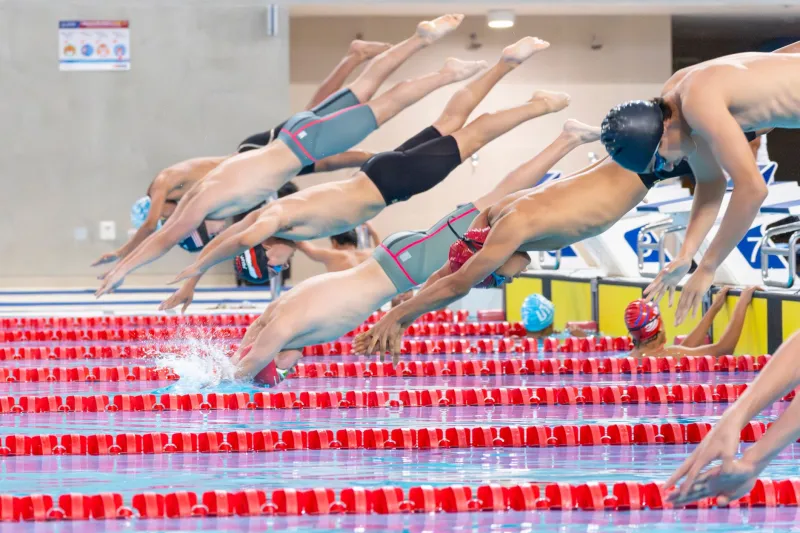
The relay exchange is supposed to give swimmers a built-in advantage. Unlike an individual event, the incoming swimmer's touch triggers the outgoing swimmer's start — which means the departing athlete is already in motion before they hit the water. In theory, that's pure free speed.
In practice, that free speed gets eaten alive by something most programs never specifically train: the receiving swimmer's launch mechanics under real-race conditions.
Here's the core problem. During an individual race, a swimmer controls their own start completely. They're on the block, focused, breathing deliberately, and timing their reaction to a single auditory cue. On a relay, the outgoing swimmer has to track a moving, fatigued athlete in the water, read the touch in real time, and fire their start at exactly the right moment — all while managing their own pre-race arousal.
That's a fundamentally different cognitive and physical task. And most training environments never replicate it with any seriousness.
What's Actually Happening at the Wall
Let's break it down mechanically. A relay exchange involves two overlapping movement chains: the incoming swimmer's finish and the outgoing swimmer's departure. The goal is to minimize the gap between the touch and the launch without causing a disqualification.
Elite relay teams time this window to within hundredths of a second. But getting there requires the outgoing swimmer to nail three things simultaneously:
1. Anticipatory timing. The outgoing swimmer needs to read the incoming swimmer's stroke cycle and begin their loading sequence — shifting weight forward, bending into the crouch — before the touch happens. Wait for the touch, and you've already lost.
2. Positional stability. The block stance during a relay exchange is different from a standing start. The athlete is in a crouched, forward-loaded position with arms in motion. If their base isn't stable — feet too wide, weight too far back, arms swinging inconsistently — their launch angle suffers even when the timing is right.
3. Mental reset speed. This one gets ignored almost entirely. The outgoing swimmer has been standing on the block watching their teammate race for 45 to 60 seconds. Their nervous system has been building arousal the entire time. When the exchange fires, they need to transition instantly from observer to competitor. Swimmers who haven't practiced that transition often launch with a slight hesitation — a micro-freeze — that doesn't show up on video but absolutely shows up in the split.
Why Your Best Swimmers Are Often the Worst Exchangers
Here's the counterintuitive part. High-performing individual swimmers can actually be harder to coach on relay exchanges, not easier.
Why? Because elite individual performers have deeply grooved start sequences built entirely around self-controlled timing. They've internalized a personal pre-race rhythm — breathing pattern, block setup, mental cue — that gets disrupted when external timing takes over. The better they are at their own start, the more jarring it feels to surrender that control to someone else's finish.
This shows up as over-anticipation (leaving early and getting DQ'd) or over-caution (waiting too long and losing the free speed entirely). Neither extreme is fast. And both stem from the same root cause: the swimmer's internal timing system fighting with the external demand of the exchange.
College relay programs at the D1 level address this by treating relay exchange training as its own discipline — separate from individual starts, with dedicated practice blocks, video review, and timing technology that gives swimmers real-time feedback on their exchange windows.
Most club and high school programs? They run the relay in practice once or twice before championship season and call it good.
What Closing the Gap Actually Looks Like
The good news is that relay exchange speed is highly trainable. It's a skill, not a talent. Here's what purposeful exchange training looks like in practice:
Isolation reps. Practice exchanges without the full 100-yard swim. Have the incoming swimmer do a 25 at race pace, touch the wall, and give the outgoing swimmer a real exchange to react to. Volume matters here — ten quality exchange reps in a practice session will do more than one full relay swim.
Timing tech. Touchpad relay timers or even basic video with frame-by-frame review let athletes see exactly when their feet leave the block relative to the incoming touch. Swimmers who get this feedback adjust quickly. Swimmers who don't get it keep guessing.
Stance standardization. Work with each outgoing swimmer to find a relay stance that's both stable and explosive. This is individual — foot width, forward lean, arm position all vary by body type. The goal is a stance they can replicate consistently under race pressure, not a textbook position.
Mental simulation. Have swimmers practice the arousal-to-action transition by watching a race clip, building intentional tension, then snapping into their launch sequence on a cue. It sounds simple. It works. The nervous system needs to practice switching modes, and it can do that without a pool.
The Tenths Nobody Counts
A four-person relay that loses two tenths per exchange loses eight tenths total — nearly a full second before anyone's even swum a length. In a sport where national championships are decided by hundredths, that's not a rounding error. That's the difference between the podium and the consolation heat.
The relay exchange isn't a formality. It's a technical event inside a technical event, and it deserves the same analytical attention you'd give to a start, a turn, or a stroke cycle. The programs winning relays at the national level understand this. They're not just assembling their four fastest swimmers. They're building a team that knows how to pass speed — not just generate it.
Your relay is only as fast as your worst exchange. Start training accordingly.