Clear Water, Blurry Truth: What Your Goggle Choice Is Really Doing to Your Race
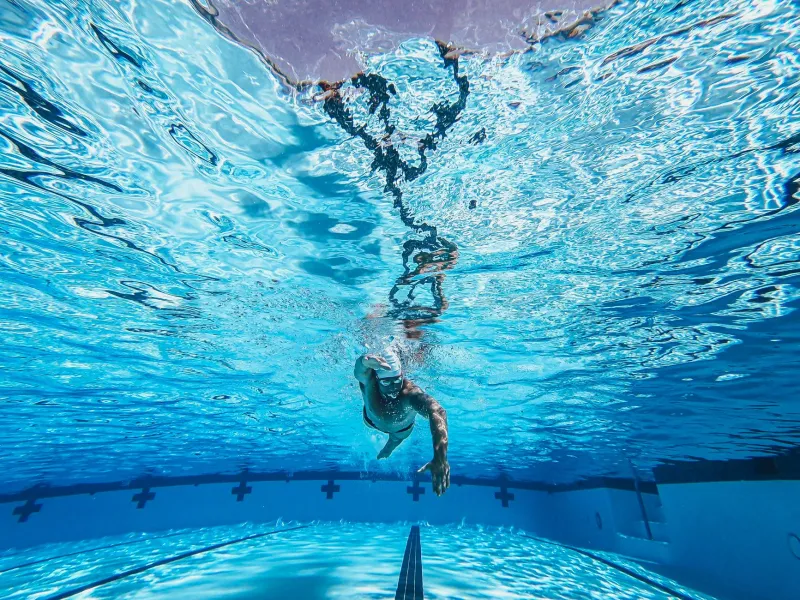
Most swimmers with less-than-perfect vision treat their goggle setup like a minor logistical detail—something you sort out in the parking lot before a meet, not something that actually affects performance. But if you've ever noticed your turns getting sloppy in the final 50, struggled to sight efficiently in open water, or felt oddly disoriented after a flip turn, your vision correction method might be doing more damage than you realize.
This isn't just about whether you can read the scoreboard. It's about how your brain processes spatial information underwater, how your vestibular system reacts to visual distortion, and how milliseconds of perceptual lag can compound into meaningful time losses across a race.
The Three Options—and Why None of Them Are Perfect
Let's lay out the playing field. Swimmers with corrective vision needs basically have three routes: prescription goggles (either custom-ground lenses or off-the-shelf diopter options), soft contact lenses worn under standard goggles, and optical insert systems that clip or press into a goggle frame independently of the lens itself.
Each has a genuine use case. Each also has a failure mode that most swimmers don't account for.
Off-the-shelf prescription goggles are the most accessible option. Brands like TYR, Speedo, and Aqua Sphere offer diopter-based lenses in increments—usually -1.0 through -8.0, sometimes with limited plus-power options. The problem? Your prescription almost certainly isn't a round number, and diopter goggles don't account for astigmatism at all. If you've got even moderate cylindrical correction in your glasses or contacts, you're already accepting a compromised visual field every time you put those goggles on.
Custom prescription goggles solve the diopter rounding problem but introduce a new one: optical center alignment. In eyeglasses, your lenses are precisely positioned relative to your pupils. Goggle frames flex, shift, and compress differently depending on face geometry and strap tension. A lens that's optically correct but physically off-center can create subtle prismatic effects—your brain compensates, but that compensation costs neurological energy you'd rather spend on pacing and stroke mechanics.
Contact lenses are, for many swimmers, the cleanest solution on paper. You get your full, precisely fitted prescription, and your goggle choice becomes entirely about fit and performance characteristics rather than optical specs. The complications are practical: water ingress from a leaky seal can flush a lens out mid-race, chlorine and salt water can irritate lens surfaces and cause acute discomfort, and extended wear lenses that some athletes use to avoid daily insertion carry their own risks in aquatic environments. The FDA has long advised against swimming in contact lenses due to infection risk from waterborne pathogens—a concern that's easy to dismiss until it isn't.
What Happens to Your Brain Underwater
Here's where it gets genuinely interesting from a performance standpoint. The human visual system doesn't work in isolation—it's constantly negotiating with your vestibular system and proprioceptive feedback to construct your sense of where you are in space. Underwater, that negotiation gets complicated fast.
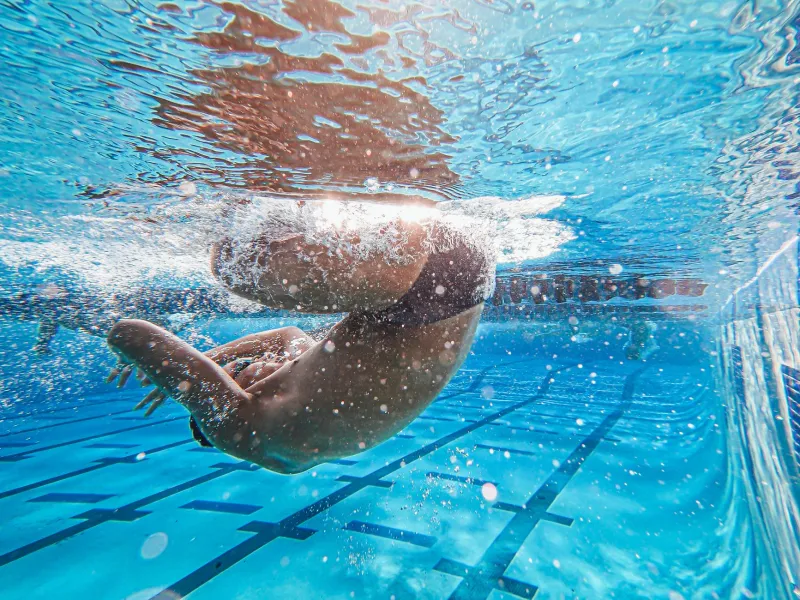
Water refracts light differently than air, which is why objects appear closer and larger when you're submerged. Goggle lenses add another refractive layer. If your prescription correction interacts with that goggle lens in a way that creates even minor distortions at the periphery of your visual field, your brain has to work harder to reconcile what it's seeing with what your inner ear is telling it about your orientation and velocity.
For sprint events—your 50 free, your 100 fly—this might be a rounding error. For longer events where you're making dozens of turns and managing pace over hundreds of meters, that cognitive overhead accumulates. Some coaches who work with visually impaired or vision-corrected swimmers have described it informally as "visual fatigue"—a degradation in spatial awareness and reaction sharpness that sets in around the midpoint of longer races and isn't explained by physical conditioning alone.
The Event and Environment Factor
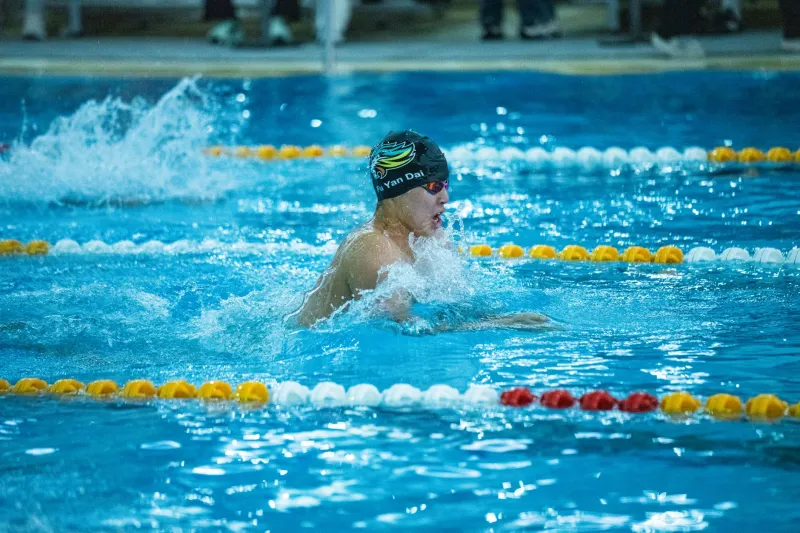
Your event genuinely changes which option makes the most sense. In short-course pool swimming, you're relying heavily on your ability to accurately judge the wall during your approach—getting that distance wrong by even a foot can cost you a clean turn. Swimmers with uncorrected or poorly corrected vision often develop compensatory habits, like counting strokes from the flags rather than visually tracking the wall, which works fine until race conditions disrupt your rhythm.
Open water is a different animal entirely. Sighting in open water requires you to lift your head, spot a buoy or landmark, and immediately reintegrate into your stroke. If your goggle correction introduces any distortion or chromatic aberration at distance, your sighting becomes less reliable—and in choppy conditions, you're already fighting enough variables without your optics adding noise.
Indoor pools with overhead lighting versus outdoor venues with sun glare also matter. Some prescription goggle lenses have tint coatings that interact with corrective optics in ways that reduce contrast sensitivity. This sounds minor until you're trying to track a black lane line in a sun-drenched outdoor pool through lenses that are doing double duty as both corrective and tinted.
What Elite Swimmers Are Actually Doing
Among high-level competitive swimmers in the US—think Division I college programs and senior national circuit athletes—the trend has been quietly shifting toward daily disposable contact lenses paired with high-performance standard goggles, specifically because it decouples the optical and hydrodynamic variables. You get your best possible vision, and you get to choose your goggle based purely on fit, seal quality, and lens characteristics rather than working around prescription constraints.
The infection risk concern is managed through diligence: fresh lenses for every practice, meticulous goggle seal checks before entering the water, and immediate lens removal if a seal fails. It's not a zero-risk approach, but the performance tradeoff calculation favors it for swimmers who can manage the discipline.
On the emerging tech side, a handful of specialty optical labs have started producing semi-custom goggle lenses that account for both spherical and cylindrical correction—essentially bringing prescription eyeglass precision to goggle form factors. They're not cheap, and availability is limited, but the concept addresses the single biggest limitation of standard prescription goggles. Worth watching as the technology matures.
The Practical Audit
If you haven't seriously evaluated your vision correction setup in the context of your specific events and training environment, it's worth doing. Start by honestly assessing whether your current setup accounts for your full prescription—sphere and cylinder—or whether you're accepting a compromise because it's convenient. Talk to a sports-oriented optometrist if you can find one, ideally one familiar with aquatic athletes.
Test your options deliberately. Swim a set with your usual setup, then swim the same set with an alternative and pay attention to how your turns feel, how your spatial awareness holds up in the back half, and whether you notice any visual fatigue. The data you collect in practice is more useful than any generalized recommendation.
Your vision is doing more work during a race than you probably give it credit for. It's worth treating it like the performance variable it actually is.