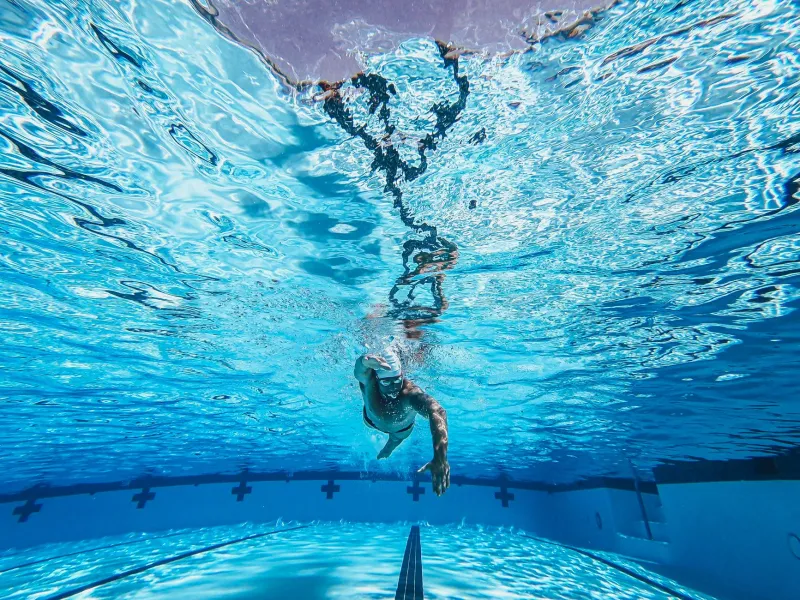
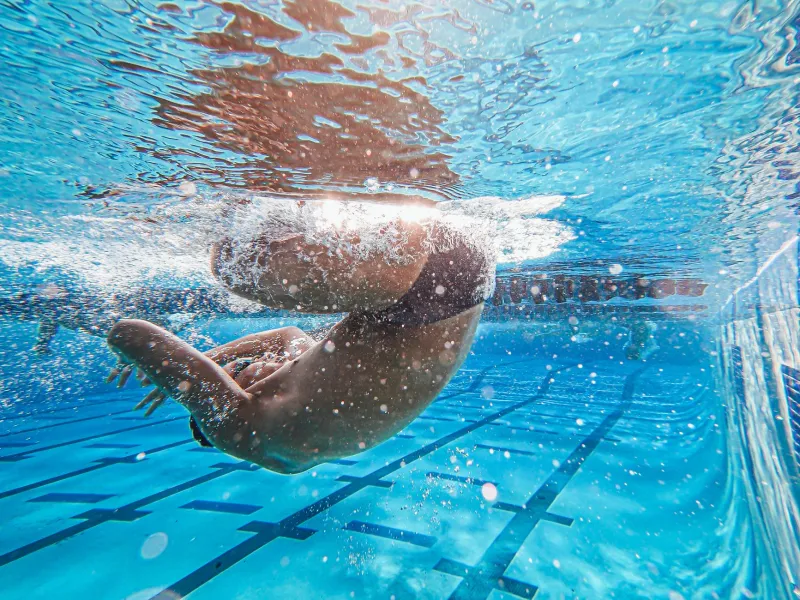
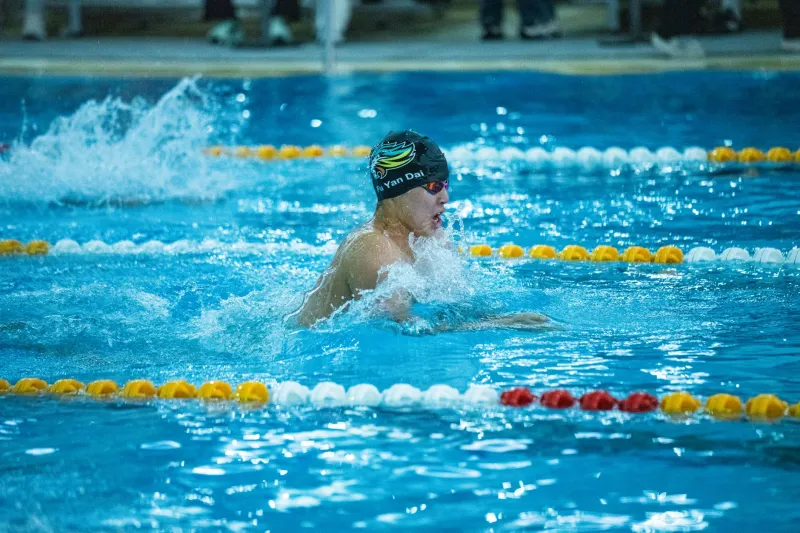
Pool Swimmer, Open Water Stranger: Why Your Flip Turn Is Working Against You
You've logged thousands of yards. You can rip through a flip turn so automatically you don't even think about it anymore. And that's exactly the problem.
For competitive swimmers who grew up training in a lane, the flip turn isn't just a technique — it's a rhythmic anchor. Your body learns to anticipate it. Your breathing pattern bends around it. Your pace is quietly structured by the fact that every 25 yards, you get a wall. A push. A free ride of momentum and a gulp of air.
Take that wall away, and suddenly your body is confused in ways you probably haven't even noticed yet.
What Your Nervous System Actually Learned
Here's the thing about long-term pool training: your neuromuscular system is incredibly good at pattern recognition. After years of structured lane work, your body doesn't just know how to flip turn — it expects to flip turn. The anticipation of the wall influences how hard you push the last few yards of each length, when you take your final breath, how much you kick, and even how your hips rotate in the water.
Researchers who study motor learning call this kind of deeply embedded habit a "movement schema" — a stored template your nervous system runs almost automatically. The problem isn't that flip turns are bad. The problem is that your schema was built in an environment that no longer exists the moment you jump into open water.
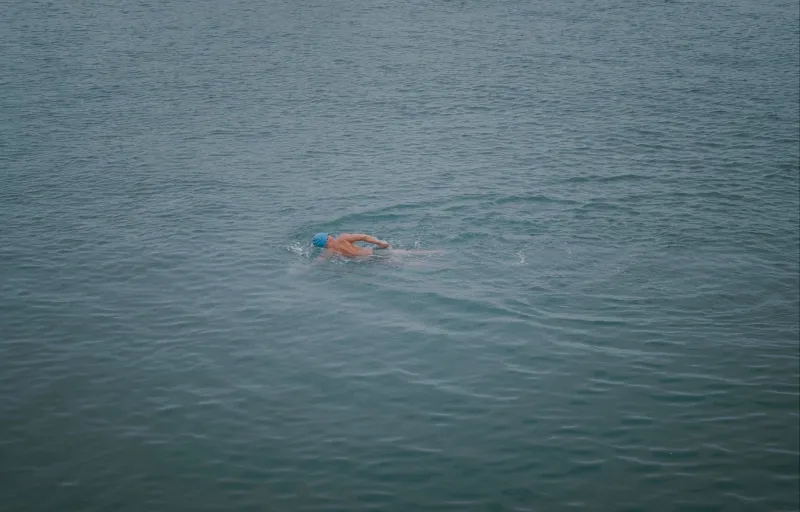
In a lake, river, or ocean race, there's no wall. No push-off. No brief reset. Just continuous, unbroken swimming — sometimes for miles. And your nervous system, trained to expect relief every 25 yards, keeps waiting for something that never comes.
The Pacing Trap Nobody Talks About
Most coaches and athletes focus on the obvious open water challenges: sighting, navigation, contact with other swimmers, currents. Those are real issues. But underneath all of that is a more fundamental pacing problem that rarely gets addressed directly.
Pool swimmers tend to pace in segments. Even when they're trying to negative split a 1500 or hold a steady effort across a set, their internal clock is calibrated to the length of a pool. They push a little harder near the wall. They ease slightly off the turn. It happens automatically.
In open water, that segmented pacing instinct has nowhere to attach. Without walls to organize effort around, many pool-trained swimmers either go out too hot — burning through reserves they'd normally conserve between turns — or they unconsciously hold back, waiting for a rhythm cue that never arrives. Both patterns hurt performance, and neither one is obvious while it's happening.
If you've ever felt weirdly flat during an open water race despite being in great pool shape, this is likely part of what's going on.
Breathing: A Pattern Built for Walls
Breathing rhythm is another place where the pool-to-open-water gap shows up hard. In pool training, most swimmers develop breathing patterns that are subtly synced to their turn cycle. You might always breathe on a specific side approaching the wall, or skip a breath on the final stroke into the turn. Over time, those habits become invisible — you don't choose them, they just happen.
In open water, especially in choppy conditions, your breathing needs to be adaptive and continuous. You can't rely on a predictable rhythm that resets every length. You need to breathe when conditions allow, not when your habitual pattern says it's time. Bilateral breathing becomes more important. Reading wave patterns and timing breaths around them is a skill that pool training simply doesn't develop.
Swimmers who haven't explicitly worked on decoupling their breathing from their turn cycle often find open water breathing feels weirdly effortful — not because their lungs can't handle it, but because their nervous system is trying to run a program that doesn't fit the environment.
Body Position Without the Boost
Here's one more piece of the puzzle that doesn't get enough attention: the push-off from a turn briefly loads your body with horizontal momentum, which naturally flattens your position and gives your stroke a cleaner platform for a few yards. In a long pool set, you benefit from this reset dozens of times.
In open water, you don't get that. Your stroke has to generate and sustain its own momentum from start to finish, with no free yards to coast on. For swimmers with a slightly high-drag position — hips sitting a little low, head slightly elevated — the wall was quietly compensating for a positioning issue they never had to fully solve in the pool.
Open water strips that compensation away. The result is more drag, more energy expenditure, and a faster onset of fatigue that feels mysterious because your pool fitness seemed totally solid.
How to Actually Bridge the Gap
The good news: this is a trainable problem. You don't need to abandon pool training — you just need to start building open water-specific patterns alongside your regular work.
Straight-line pool sets. Once or twice a week, do sets where you deliberately ignore the wall. Push off easy, don't use the turn for momentum, and focus on sustaining your effort as if the pool were endless. It sounds simple but it forces your nervous system to stop leaning on the wall.
Breathing pattern disruption. Practice switching your breathing pattern mid-set. If you normally breathe every three strokes to the left, switch to every two on the right for a few laps. The goal is to make your breathing responsive rather than automatic.
Open water simulation sets. Long, unbroken swims — even in a pool — where the goal is smooth, continuous effort without mental checkpoints at the walls. Some coaches use tethered swimming or long-course pools specifically for this purpose.
Actual open water time. There's no full substitute. If you're targeting open water races, get in open water regularly during training season. US masters programs, local tri clubs, and organized open water swims through groups like USMS are solid places to start finding those opportunities.
The Recalibration Is Worth It
Pool swimming and open water swimming share a lot of the same physical demands, but they're different sports in meaningful ways. The flip turn isn't just a technique you can leave behind at the pool deck — it's a habit your whole body has organized around, and breaking that dependency takes deliberate work.
The swimmers who make the cleanest transition are the ones who recognize this gap early and train for it specifically, rather than assuming pool fitness will automatically carry over. It won't — not completely. But once you've done the recalibration work, you'll find that your pool base gives you an enormous advantage in open water. You just have to earn the right to use it.