Wall to Water: The Underground Science Behind Elite Underwater Breakouts
The Race Before the Race
Here's something most casual swim fans never notice: the swimmer who hits the wall first doesn't always finish first. Watch any elite 100-meter freestyle heat closely — especially in the back half — and you'll start to see it. One athlete pushes off clean, goes deep, and surfaces at the 15-meter mark already at full stride. Another touches a half-second earlier but surfaces choppy, high in the water, burning energy just to get back on top.
That gap? That's the flip turn revolution in action.
Over the past five years, collegiate and elite-level coaches across the US have been quietly overhauling how they teach the flip turn — not just the rotation itself, but the full sequence from approach to breakout. What used to be treated as a transition is now treated as a weapon.
What Actually Changed
For decades, coaching cues focused on the obvious stuff: tight tuck, fast rotation, explosive push. Those fundamentals haven't gone anywhere. But what's shifted is the level of detail coaches are applying after the feet leave the wall.
"We used to coach the turn and then kind of let the underwater happen," says one NCAA Division I swim coach who works with sprinters at a major Big Ten program. "Now the underwater breakout is its own event. We spend as much time on the first five dolphin kicks as we do on the entire stroke cycle."
That shift is backed by some compelling physics. The wall push-off generates a burst of velocity that no amount of arm pulling can replicate from a dead start in open water. The goal is to preserve that velocity as long as possible — and that's where dolphin kick efficiency becomes everything.
The Biomechanics Breakdown
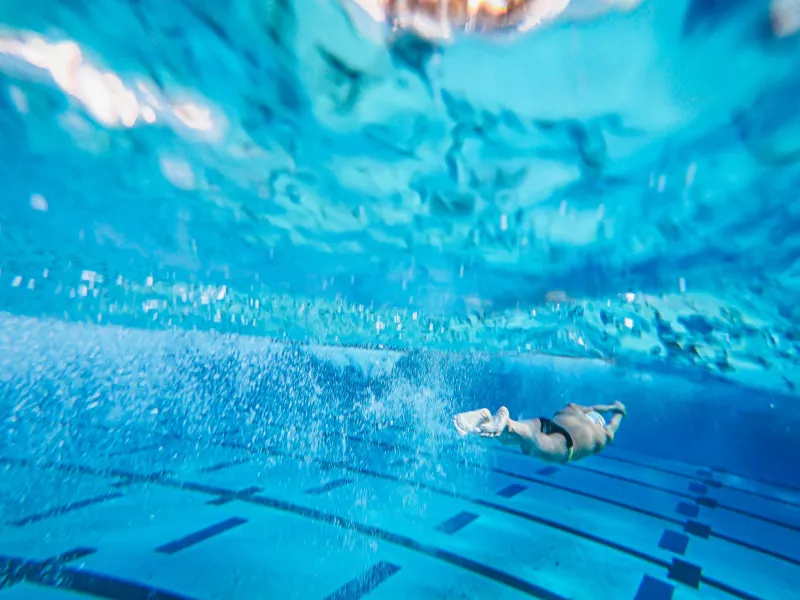
Here's what the science actually tells us. When a swimmer pushes off the wall, peak velocity typically hits somewhere between 0.5 and 1.5 meters off the surface. After that, drag starts doing its dirty work. The swimmer's job is to maintain as much of that speed as possible until the point where stroking becomes more efficient than kicking.
For most elite athletes, that crossover point lands right around the 10- to 12-meter mark — well short of the legal 15-meter limit. The swimmers who consistently surface closer to 15 meters aren't just kicking harder; they're kicking smarter.
Key variables include:
- Body position and depth: Slightly deeper entries reduce surface drag during the first few kicks. Too deep, though, and the swimmer spends extra energy angling back up.
- Kick amplitude: Bigger isn't better here. Shorter, faster kicks tend to preserve velocity better than wide, sweeping ones that create unnecessary frontal drag.
- Hip-to-toe sequencing: The most efficient dolphin kicks initiate from the core and hips, not the knees. Knee-dominant kicking bleeds speed fast.
- Breakout timing: Surfacing even one kick too early can cost a swimmer two-tenths of a second per turn — and in a 200-meter race, that math gets ugly fast.
What Pro Programs Are Actually Doing
Some of the most innovative underwater work happening right now is in US college programs and at Olympic Training Center-affiliated clubs. Video analysis tools — including underwater cameras positioned at the 5, 10, and 15-meter marks — have become standard in high-level programs, letting coaches frame-by-frame compare kick cycles and surface angles.
Drills that are showing up in elite training sets include:
The Velocity Hold Drill: Swimmers push off the wall and try to maintain a target speed (measured via in-pool timing systems or pace clocks) for as long as possible before surfacing. The goal is to identify the exact kick count where speed drops below stroke threshold.
Single-Leg Dolphin Kick Sets: Isolating each leg during kick-only underwater laps helps swimmers identify asymmetries — one weak leg can throw off the entire undulation chain and bleed speed on every turn.
Resisted Breakout Work: Using drag socks or parachutes during underwater kick-only repeats builds the specific strength needed to maintain kick power when fatigue sets in late in a race.
Tempo-Focused Turn Repeats: Short sets of 4x25 on tight rest, where the only coaching focus is turn execution, allow for high-repetition refinement without the noise of a full race-pace effort.
The Mental Side Nobody Talks About
Here's a wrinkle that coaches bring up more than you'd expect: the underwater breakout is also a confidence play. Swimmers who know their turns are elite tend to race differently. They approach walls with aggression rather than hesitation. They trust the push and commit to the underwater without second-guessing their depth or kick count.
That trust gets built in practice — specifically in the kind of repetitive, detail-obsessed turn work that doesn't feel glamorous but shows up on the scoreboard.
"When my athletes know their underwater is a strength, they stop fearing the walls," one coach noted. "They start hunting them."
Steal These Reps
If you want to start applying this at your own club or training program, here's a simple weekly structure that high-level programs use:
- Two turn-focused sessions per week — not entire practices, but 15-20 minutes of deliberate, low-fatigue turn work at the start of practice when the nervous system is fresh.
- Video review once per week — even a phone propped against the lane rope for underwater footage will reveal things you can't feel in the water.
- Count your kicks every underwater — not to hit a specific number, but to build awareness of when you're rushing the surface out of habit versus actually hitting your breakout point.
The wall isn't just a place to change direction. Treat it like a launchpad, and you'll start seeing times you didn't think were possible — one turn at a time.