Stronger Isn't Always Faster: The Core Stability Gap Killing Your Pool Performance
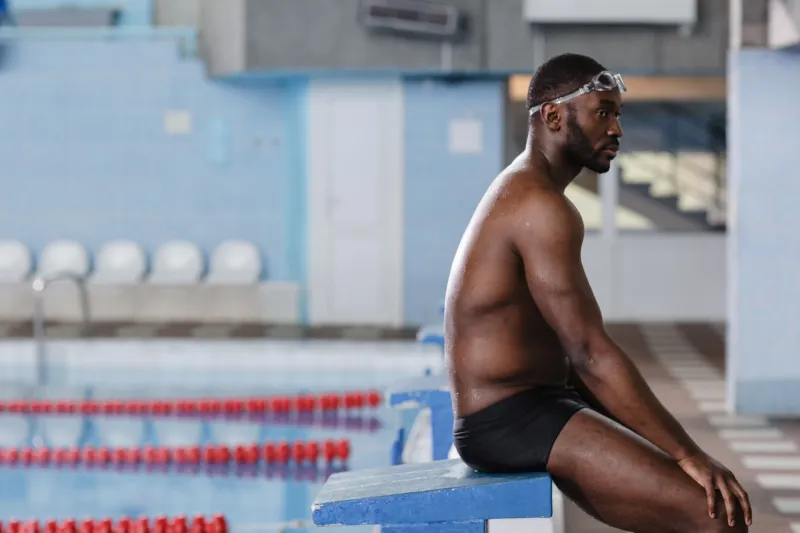
Let's paint a familiar picture. You spend three mornings a week in the weight room. Your squat numbers are climbing. Your lat pulldowns feel effortless. You show up to practice feeling like an absolute unit — and then you hop in the water and your times are exactly the same as they were six months ago.
Frustrating? Absolutely. Surprising? It shouldn't be.
The truth is, a lot of competitive swimmers in the US are falling into what coaches quietly call the "gym trap" — the assumption that raw land-based strength automatically translates into aquatic performance. It doesn't. At least, not without the one thing most dryland programs completely ignore: sport-specific core stability in the water.
What "Core Stability" Actually Means for Swimmers
When most people hear "core stability," they think planks and sit-ups. Maybe some Pilates. But aquatic core stability is a fundamentally different animal.
In the water, your body is constantly fighting buoyancy, drag, and rotational forces simultaneously. Every stroke cycle demands that your trunk act as a rigid, efficient force transmitter — channeling power from your hips and shoulders into forward propulsion. If that central connection is unstable, energy leaks. It's that simple.
Think of it like a garden hose. Crank up the water pressure all you want, but if there's a kink in the middle, you're not getting full flow at the end. Your gym-built strength is the pressure. Your aquatic core stability is the hose. Without a straight, solid connection, the output suffers.
Researchers studying competitive swimmers have consistently found that athletes who demonstrate high scores on land-based strength assessments don't always outperform their less "jacked" counterparts in the pool. The differentiating factor is almost always positional control and rotational stability during actual swimming movements.
Why the Kickboard Reveals Everything
Here's a simple field test coaches use to expose this gap: watch a swimmer do a full 200-yard kick set on a kickboard at race effort.
An athlete with solid aquatic core stability will maintain a flat, horizontal body position throughout. Their hips stay high. Their kick is compact and originates from the hip, not the knee. Their shoulders barely move.
An athlete with weak aquatic core stability — regardless of how strong they are on land — will start to snake. Their hips drop. Their kick gets wider and sloppier. Their upper body starts compensating, rocking side to side. By the second 50, they're creating drag faster than their legs are generating thrust.
The kickboard, ironically, removes the arm contribution that many swimmers unconsciously use to mask their core instability. It strips the stroke down to its structural foundation. What you see there is the truth.
The Disconnect Between the Weight Room and the Lane
So why does this gap exist in the first place? A few reasons.
First, most dryland strength training happens in stable, gravity-dominant environments. Barbells, machines, benches — these tools are designed to load the body vertically. Swimming is a horizontal, fluid-resistance sport. The neuromuscular patterns you build pressing weight overhead don't automatically transfer to stabilizing your lumbar spine while rotating at 1.5 meters per second through water.
Second, traditional strength training tends to develop global muscles — the big movers like glutes, lats, and quads. Aquatic stability demands that your deep stabilizers, the transverse abdominis, multifidus, and internal obliques, fire in precise coordination during dynamic movement. These muscles aren't the ones getting worked when you're grinding through a deadlift set.
Third, there's a timing issue. In the water, stability isn't static — it's reactive. Your core has milliseconds to respond to the force of each stroke and each kick. Building that reactive firing pattern requires water-based training, not just gym work.
How to Know If Your Dryland Training Is Actually Working
Before you overhaul your entire off-deck program, do an honest assessment. Here's what to look for:
In the water: Does your body position stay flat when you're fatigued? Do you maintain your stroke mechanics through the back half of a race, or does everything fall apart? If you video your underwater from the side at the 75-yard mark of a 100, do you look like the same swimmer you were at the 15-yard mark?
On land: Can you hold a dead bug exercise with perfect lumbar contact for 30 seconds per side without losing position? Can you perform a Pallof press without your hips shifting? These aren't glamorous tests, but they reveal whether your deep stabilizers are actually online.
In practice: Ask your coach to watch specifically for hip drop during freestyle rotation. If your hips are dropping more than 15 to 20 degrees below horizontal on your breathing stroke, you've got a stability issue, not a strength issue.
Building the Bridge Between Gym and Pool
The fix isn't to abandon your dryland work. Strength training matters enormously for injury prevention, power development, and long-term athletic longevity. The fix is to build a bridge.
Start incorporating what sports scientists call "aquatic-specific stability" exercises into your dry training. These are movements that mimic the rotational, horizontal loading patterns of actual swimming. Think: cable chops performed at torso height, single-leg Romanian deadlifts with a rotational reach, and prone plank variations with alternating arm extensions that challenge anti-rotation under fatigue.
Then — and this is the step most programs skip — bring that stability work into the water explicitly. Drill sets aren't just for technique refinement. They're stability training. Catch-up drill, fingertip drag, and single-arm freestyle all force your core to stabilize under the exact loading conditions you'll face in competition.
Finally, use race-pace work to test the transfer. If your stroke mechanics hold up at 95% effort for a full 100, your stability is translating. If they don't, you've found where to focus.
The Bottom Line
Gym strength is a tool, not a guarantee. The athletes who actually get faster aren't always the ones lifting the most weight — they're the ones who've figured out how to express that strength through a stable, controlled body in the water.
Forge the strength. Then forge the stability to use it. That's where the real speed lives.