The Hidden Engine: How Your Dolphin Kick Is Quietly Deciding Every Race You Swim
The 15 Meters Nobody Is Watching (But Should Be)
Watch any elite swimmer at a high-level US meet — a college conference championship, a USAS sectionals, even a strong local invitational — and you'll notice something that doesn't show up in the official splits. The swimmers who look effortless in the open water? They're usually doing something very different under the water.
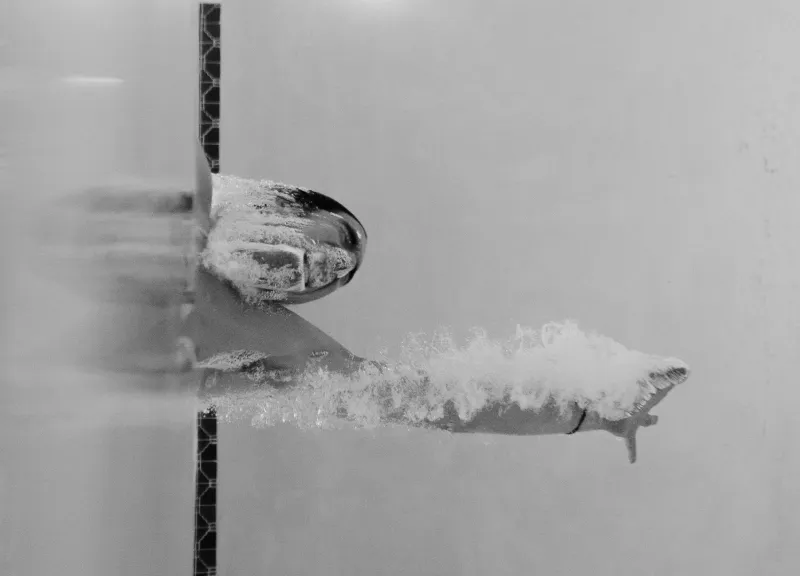
The underwater phase — from the push-off through the breakout — is where races quietly get decided. In a 100-yard freestyle, a swimmer might spend 20 to 30 percent of the entire race submerged. In the 100 fly, that number can be even higher. And yet most training programs spend less than five percent of their time developing that phase deliberately.
The dolphin kick is the engine of your underwater. And for most swimmers, it's running on two cylinders when it could be running on six.
Why the Dolphin Kick Is Biomechanically Unique
Unlike the flutter kick, which relies heavily on the lower leg and ankle, a powerful dolphin kick is a full-body movement. It originates in the core — specifically the hip flexors, glutes, and lumbar stabilizers — and travels through the hips and thighs before finishing with a sharp ankle snap.
That wave-like kinetic chain is what makes the kick simultaneously difficult to learn and incredibly rewarding to develop. When the sequence is right, propulsion is generated through the entire body rather than just the feet. When it's wrong — when a swimmer initiates from the knees instead of the hips, or collapses through the core — the kick becomes drag, not drive.
Here's the key distinction coaches emphasize at the elite level: amplitude and frequency are not the same thing, and optimizing both is the whole game.
Amplitude refers to the size of the kick — how much vertical displacement the body generates. Frequency is how many kicks per second the swimmer executes. Most developing swimmers default to one of two failure modes: big, slow kicks that look powerful but generate too much drag, or fast, shallow kicks that create little actual propulsion. The sweet spot — the one elite swimmers train for years to find — is a compact, rhythmic kick with just enough amplitude to generate thrust without creating resistance.
What the Data Actually Shows
A study conducted with collegiate swimmers found that underwater dolphin kick velocity was, on average, faster than open-water swimming velocity across nearly every stroke and distance tested. That's not a marginal difference — it means every wall is a speed opportunity that most swimmers are leaving on the table.
The best breaststrokers in the world have known this for decades. The underwater pullout, which includes a single powerful dolphin kick, is so critical to 200-meter breaststroke performance that elite coaches often spend entire training cycles dedicated to it alone. Butterfly and backstroke specialists have followed suit, and now the principle has fully migrated to freestyle — which is why you see swimmers like Caeleb Dressel and Ryan Murphy spending the first third of every 50 meters completely submerged.
The Dryland Foundation Most Swimmers Skip
You can't dolphin kick well in water if you can't generate power from the right muscles on land. Most swimmers who struggle with their underwater phase have a core or hip-strength deficit that no amount of pool repetition will fix on its own.
These dryland movements address the root issues directly:
Hip Hinge Variations (Romanian Deadlifts, Good Mornings): The dolphin kick's power comes from hip extension. If your hamstrings and glutes aren't strong through a full range of motion, your kick will be ankle-driven and weak. Two to three sets of 8–12 reps, two days per week, is a sustainable starting point.
Hollow Body Holds and Hollow Rocks: Core stability is the conduit through which hip power travels to the feet. Without it, energy leaks. A swimmer who can't maintain a tight hollow position for 30 seconds on land is going to lose that position the moment they push off a wall at race speed.
Banded Hip Flexion Drills: Attach a resistance band to a low anchor, loop it around one ankle, and drive the knee toward the chest against resistance. This isolates the hip flexors — the often-neglected "up kick" drivers — which are just as important as the glutes in a complete dolphin kick cycle.
Ankle Flexibility Work: Plantar flexion range of motion directly limits how much propulsive surface area the foot creates at the finish of each kick. Daily ankle circles, seated towel stretches, and kneeling ankle stretches can meaningfully improve this over 8–12 weeks.
In-Water Progressions That Actually Stick
Dryland builds the engine. Pool work teaches the swimmer how to use it. Here's a progressive sequence worth running over a 10–12 week block:
Weeks 1–3 — Isolation and Awareness: Vertical kicking drills with hands at sides. Kick on your back to remove the visual distraction of the surface. Slow everything down and feel where the motion is initiating from. Video yourself from the side if possible — most swimmers are shocked at what they see.
Weeks 4–6 — Streamline Integration: Add full streamline underwater repeats at submaximal effort. Focus on maintaining a tight, narrow body position while sustaining kick rhythm. 6x25 off the wall with 30 seconds rest is a solid early-block set.
Weeks 7–9 — Speed Application: Begin incorporating max-effort underwater repeats at race distance. 8x25 all-out underwater to the flags, full recovery between reps. You're training the nervous system now, not just the muscles.
Weeks 10–12 — Race Integration: Attach the underwater work to race-pace sets. After a flip turn in a 10x100 set, the first 12 meters off every wall are treated as a maximum-effort underwater — not a transition. This is where the skill becomes automatic.
The Mental Side of Going Under
Here's something coaches don't always say out loud: a lot of swimmers are subtly afraid of their underwaters. Not in a dramatic way — but there's a low-grade discomfort with the breath hold, the pressure, the visual isolation of being fully submerged at race speed. That discomfort causes early breakouts, reduced kick intensity, and a general reluctance to commit to the phase.
Addressing this is genuinely part of the training. Breath control work — static apnea holds in the shallow end, underwater distance challenges at low intensity — builds both physiological tolerance and psychological comfort. The swimmer who trusts their underwater doesn't just kick harder. They kick longer, later, and with more consistency when it actually counts.
The Bottom Line
Your stroke is the face of your swimming. Your dolphin kick is the foundation it's built on. If you've been grinding through yardage, obsessing over stroke count, and wondering why your times aren't moving — spend four weeks genuinely prioritizing what happens in those first 12 meters off every wall.
The results tend to be fast, measurable, and a little humbling. In the best possible way.